
A disorganized storage unit doesn’t just frustrate you; it costs you money. Every minute spent hunting for a product, tripping over boxes, or repacking a misplaced order is time pulled away from running your business. The good news is that square footage matters far less than how you use it.
Whether you’re a small business owner in Massachusetts managing seasonal inventory or a contractor in Georgia storing job-site supplies, a well-planned storage unit can function as a true operational hub. The key is intentionality. Today, Compass Self Storage will walk you through a practical, step-by-step system to maximize storage space, cut retrieval time, and build a workflow that actually holds up under real business pressure.
Why Workflow Matters More Than Square Footage
Most business owners upgrade to a larger unit when things start to pile up, but the problem usually isn’t space; it’s organization. A poorly laid-out 10×10 unit will underperform a well-organized 5×5 unit every time. Renting more space without fixing the underlying system just means paying more for the same inefficiency.
When set up with purpose, even a compact unit becomes a legitimate business storage solution. E-commerce sellers can pick and pack orders, contractors can stage equipment by job, and retailers can rotate seasonal stock, all from a single, well-structured space. The layout you choose on day one determines whether your unit supports your growth or slows it down. Treat it like a workspace, not a closet.
Map Your Unit Before You Move a Single Box
Before loading anything, sketch a simple floor plan; even a rough hand-drawn diagram works. Visualizing the space in advance helps you define traffic flow and avoid the common mistake of blocking your most-used items behind bulk stock.
Divide the unit into three functional zones:
- Active pick zone: Items you access daily or weekly, positioned within arm’s reach of the entry.
- Bulk storage zone: Reserve inventory, seasonal stock, or wholesale quantities stored toward the back.
- Staging area: A clear space near the door for receiving shipments, packing orders, or sorting returns.
If your unit has drive-up access, treat the threshold as a loading dock. Loading and unloading becomes linear with no hauling through hallways or up stairs. This single feature can dramatically streamline the receiving side of your workflow. For inventory that’s sensitive to temperature swings, such as candles, cosmetics, or electronics, a climate-controlled storage unit with a consistent temperature range helps protect product quality year round.
Build Vertical and Reclaim Your Space
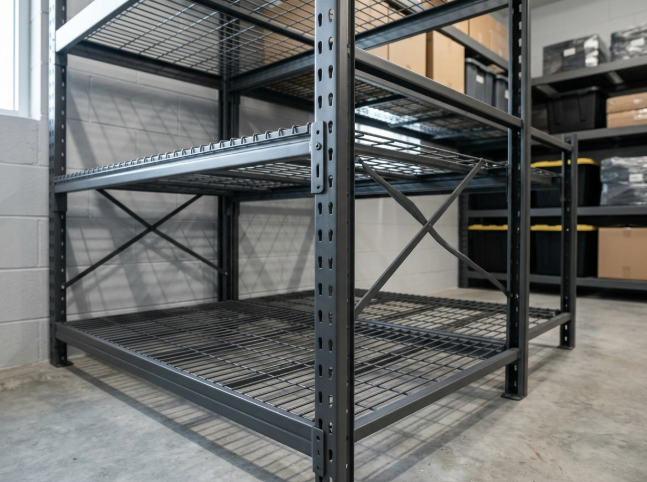
Wall space is free real estate. Freestanding wire or metal shelving units that run floor to ceiling are the single highest-impact investment you can make in any unit size. Going vertical instantly multiplies your usable capacity without requiring a larger unit.
A few commercial storage tips to get the most from your shelving setup:
- Use uniform bin sizes: Consistent containers stack easily and make contents visible at a glance.
- Label by category or SKU range: This scales as inventory grows, so you’re not relabeling constantly.
- Keep a center aisle clear: Even in a 5×5 unit, a defined walkway keeps the space functional when stock levels rise.
- Add pegboards or magnetic strips: Mount these on side walls to hold packing supplies, tools, or frequently grabbed accessories — freeing up shelf space for actual inventory.
Clear containers deserve special mention. Being able to spot contents without pulling every bin off the shelf reduces retrieval time significantly, which matters when you’re fulfilling orders under time pressure. Small business owners managing storage for e-commerce inventory will feel this benefit immediately.

Establish a Repeatable Inventory Routine
Organization without maintenance deteriorates fast. A consistent routine is what separates a unit that works on day one from one that still works six months later.
Build these habits into your weekly schedule:
- Run a 15-minute weekly audit. Reconcile physical stock against a spreadsheet or inventory app. Catching discrepancies early prevents fulfillment errors downstream.
- Follow a first-in, first-out rotation. New stock goes to the back or bottom; older stock moves forward. Nothing gets buried or expires unnoticed.
- Post a one-page SOP inside the door. A simple visual map and zone guide keeps the system intact when someone else accesses the unit in your absence.
- Track the unit as a business expense. Calculating your cost-per-order helps you evaluate when it makes financial sense to scale up or down.
On the lease side, a month-to-month agreement gives you the flexibility to adjust unit size as your inventory fluctuates seasonally. Locking into a long-term commitment when your storage needs shift quarterly rarely makes sense for small businesses. Compass Self Storage facilities across the country offer this kind of flexible lease structure for exactly this reason.
Your Next Step Toward a Smarter Storage Operation
The framework is straightforward: plan your zones before loading anything, build vertically to maximize space, and maintain a consistent inventory routine. These three habits transform a storage unit from a dumping ground into a genuine operational asset.
The right unit features matter just as much as organization. Drive-up access keeps your workflow linear. Climate-controlled options help protect temperature-sensitive products. A month-to-month lease lets you scale without penalty. For small businesses managing e-commerce inventory or commercial stock on a flexible budget, getting these details right is a real competitive advantage.
If you’re ready to put this system into practice, explore storage locations in Georgia or find a facility near you to walk through available unit sizes in person. And if you’re in the Atlanta metro area, our self storage facilities in Marietta offer the drive-up access and flexible lease options that make this kind of workflow setup practical. Reserve your unit with Compass Self Storage today.