
Most landscaping crews spend the busy season focused on the next job. Then mowing season winds down, and there’s a trailer full of equipment sitting in the driveway, a shop packed with hand tools, and a mower that hasn’t been cleaned since its last cut. Equipment left wherever it lands until spring can lead to stale fuel, rusted blades, and repair bills before the first lawn of the new season gets cut.
Good offseason storage comes down to three questions: what you own, what each piece needs before it goes into storage, and where it all fits. Answer those now with help from Compass Self Storage, and your crew starts spring with fewer surprises.
Take Stock Before You Store Anything
The offseason is the right time to audit your equipment before anything goes into a storage unit. Walk through everything you own and sort it between what’s ready for storage and what needs servicing first. Blades that go in dull come out dull, and a mower with old fuel sitting in the carburetor will give you trouble in March.
Before loading the unit, drain fuel in small engines, clean grass and debris off cutting decks, and wipe down metal surfaces so moisture doesn’t sit on them for months. Leave gas cans and chemicals out of the unit, since most storage facilities restrict flammable and hazardous materials. This is also a good time to note what’s worn out and needs replacing, since storing broken equipment only delays the decision and takes up room in the unit.
Choosing the Right Unit Size for Landscaping Equipment
Unit sizing is where many landscapers get tripped up. It’s easy to underestimate how much room a full season’s worth of equipment takes up once it’s organized properly instead of stacked in a garage corner.
A solo operator with a walk-behind mower, a trimmer, a blower, and a few hand tools can often fit into a 5×10 storage unit. A crew running a zero-turn mower, multiple trimmers, a backpack blower, an edger, and a collection of rakes and shovels will likely need a 10×10 or 10×15. Since storage unit sizing is all about floor space, measure your largest mower and your trailer first, then size up to a 10×20 or larger drive-up storage unit if the trailer is coming along.
Why Drive-Up Access Matters for Landscaping Equipment
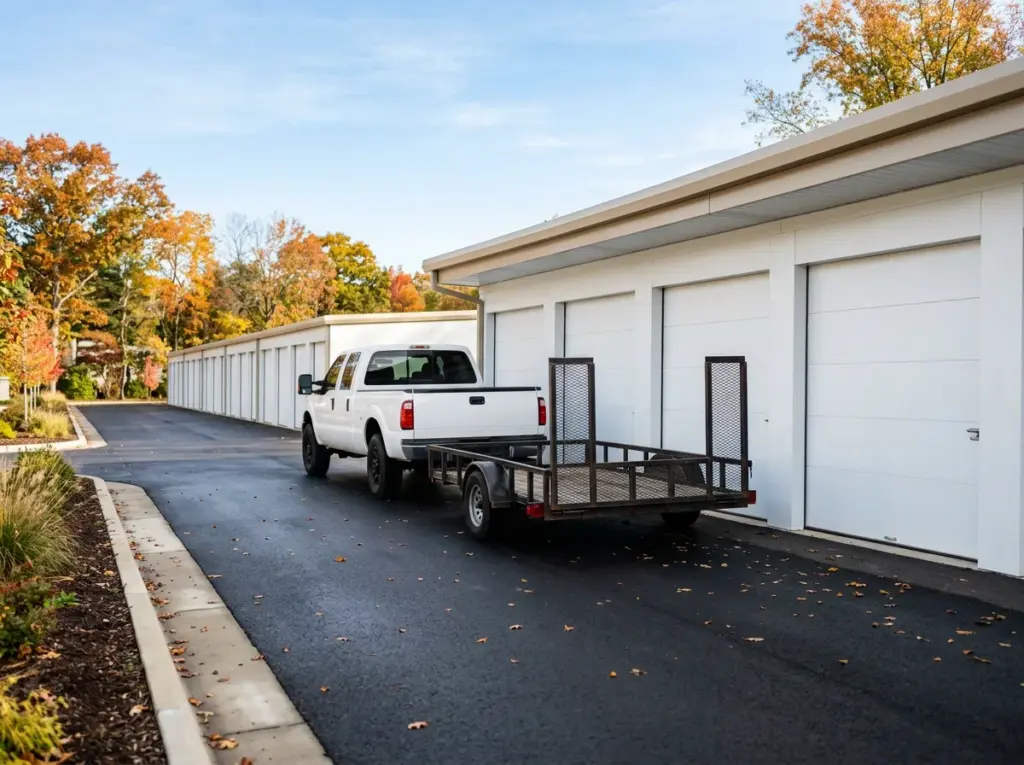
For landscapers, drive-up access is a practical requirement. Nobody wants to wheel a zero-turn mower through a narrow interior hallway. A drive-up storage unit lets you back a trailer to the door, roll equipment out without lifting it over curbs or thresholds, and load up quickly when a job comes in.
Drive-up access also helps when the weather turns. Once the mowers are put away, the same storage unit can hold snow blowers, plows, and bags of ice melt, so you can swap equipment in and out as the season changes without rearranging the whole shop.
When you compare storage facilities, confirm that the drive-up units are wide enough for your trailer and that the drive lanes can handle a truck-and-trailer combination, since tight turns can make longer rigs difficult to maneuver.
How To Organize a Storage Unit for a Landscaping Business
A storage unit that’s easy to get into in October can turn into a puzzle by February if it wasn’t organized with retrieval in mind. Plan the layout around what you’ll need first.
Large equipment like mowers and aerators goes to the back, while anything you might pull out midwinter, such as a snow blower or a backup trimmer for a one-off job, stays near the door. Shelving along the walls holds hand tools, accessories, and small power equipment, which keeps the floor clear and makes the space easier to move through.
Label every bin. Spare parts, hardware, and small accessories look identical from the outside, and a label on the front of each bin saves time on every visit. Irrigation parts, spreaders, and job-site supplies add another layer of clutter, and our tips on the best shelving and labeling systems contractors use work well for landscaping crews too, since crews in each trade pull small parts and tools on tight schedules.
Climate-Controlled Storage for Battery-Powered Equipment
Most landscaping equipment can sit in a standard drive-up storage unit, but battery packs and electronics are an exception. Lithium-ion batteries stored through repeated freeze-and-thaw cycles can lose capacity over time, and rubber hoses, belts, and seals can crack or stiffen under the same temperature changes.
If your crew relies on cordless equipment or you’re storing irrigation controllers and timers, our climate-controlled storage units hold a more consistent temperature range through the winter and help maintain the condition of those parts. Purely mechanical equipment with no electronics usually does fine in a standard drive-up unit.
Month-to-Month Leases for Seasonal Businesses
Landscaping is a seasonal business in most markets, so a long-term storage commitment doesn’t always make sense. A month-to-month lease lets you rent a larger storage unit during the offseason, then downsize or move out when the equipment goes back into rotation.
That flexibility also helps as your business grows. A second crew means more equipment, and using a storage unit for your business means your space can scale with your operation, since you can move into a larger unit without waiting out a long lease.
Find a Location Close to Your Service Area
Proximity matters when you’re running a working business. A storage facility far outside your service area adds drive time to every trip, while a storage unit close to your regular routes lets you stop by before or after a job without a detour.
Compass Self Storage has storage facilities in multiple states, so there’s a good chance one already sits near the neighborhoods your crew works most. Contact us or call us today to rent a storage unit that fits your equipment and your routes.
The offseason is short, and spring has a way of arriving before you’re ready. A storage unit with drive-up access, the right footprint for your gear, and a location along your routes lets your crew create room at home and in the shop now, then start next season with equipment that’s ready to work.